Mission & Vision
A DSIR-sponsored initiative at IIT Kharagpur translating research in basic sciences, sensors and digital health into affordable, deployable healthcare technology.
Innovation plays a critical role in shaping the industrial competitiveness of any nation. India, being a developing nation, has its own set of unique situations and challenges that impede the innovation potential of MSMEs operating in it. Many of these challenges are related to public policy, funding constraints, access to suitable equipment, shortage of skilled R&D workforce and weak linkages between institutions and industry. DSIR has therefore initiated a program aimed at the creation of Common Research & Technology Development Hubs (CRTDHs) to encourage research and technology development by MSMEs and develop synergy between academia and industry, facilitating hands-on training, skill development and R&D infrastructure.
DSIR-CRTDH is now a strong family of 18 CRTDHs located across the country, working in sectors such as electronics/renewable energy, affordable health, environmental interventions, low-cost machining and new materials/chemical processes — all engaged in R&D activity with real societal impact, helping MSMEs remain competitive while DSIR expands the network across every state and Union Territory.
Almost half of the world's population is forced to live without access to basic healthcare, health education and public health measures — a cycle that pushes millions below the poverty line every year through health-related expenses. Breaking that cycle means intermingling advances in healthcare technology, including digital healthcare, with value-added human resource development — the central principle behind CRTDH's vision at IIT Kharagpur.
The CRTDH for Affordable Health at IIT Kharagpur was established in 2019 to support MSMEs, startups and entrepreneurs working in the healthcare domain, offering R&D support, state-of-the-art facilities, a manufacturing plant and licensing support. In spite of the constraints of the COVID-19 pandemic, CRTDH developed several point-of-care technologies, trained community health workers, ran medical and validation camps in remote settings, and set up a Pathology and Imaging Lab in collaboration with an NGO — continuing to make healthcare accessible to the last-mile population.
Where we work
Affordable healthcare for a billion people
Diligence in Basic Sciences and Mathematical Modelling
- Medical Device and Diagnostics
- Sensors & Materials for Healthcare
- System Modeling
- Technology for Healthcare
- Understanding the Science of Human Health
- Digital Convergence in Medical Technology
- Interconnection of Biosystems
How CRTDH supports MSMEs
| Stage | Task | Outcome |
|---|---|---|
| Ideation | MSMEs state their ideas about new products/services based on their understanding of market needs | Builds two-way traffic for idea-sharing and more relevant products |
| MSMEs state their ideas about new products/services based on their understanding of market needs | Selection of product/device/service | |
| Capacity-building | Hands-on training to MSMEs for prototype development using CRTDH facilities | Addresses the key challenge of 'Training & R&D Capability' for MSMEs |
| Imparting fundamental knowledge to MSMEs about the technology platform of the device/service and how it works | — | |
| Key risks mitigation | Provide access to rural healthcare network and super-speciality hospitals for initial validation study of the device/service | Addresses the challenge faced by MSMEs towards investment in risky early-stage development |
| Patenting support | — | |
| Data analysis and iterative development for MSMEs | — | |
| Develop product to 'Design-for-Manufacture' stage | — | |
| Trial and final validation | Create access for MSMEs to multi-centric trials with appropriate IRB clearances | Provides a knowledge base for conducting validated trials and data analysis |
| Data analysis and validation | — | |
| Technology transfer | Transfer technologies to MSMEs through appropriate agreements on royalty share | — |
| Certification | Assist MSMEs through the certification process | Assistance in regulatory clearances |
| CDSCO, DCGI, CE, European CE, ISI, BIS (as appropriate) | — | |
| Initial market access | Provide immediate sale support to MSMEs via access to IIT Kharagpur's rural healthcare network, building initial confidence and success stories | Initial sale and revenue stream creation |
Healthcare ecosystem at IIT Kharagpur
- 2001

School of Medical Science and Technology
- 2013-14
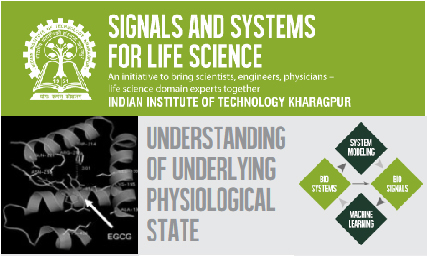
Signals and Systems for Life Science
- 2021
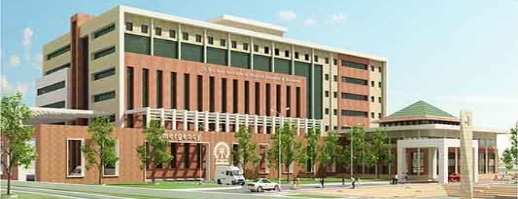
Super Specialty Hospital
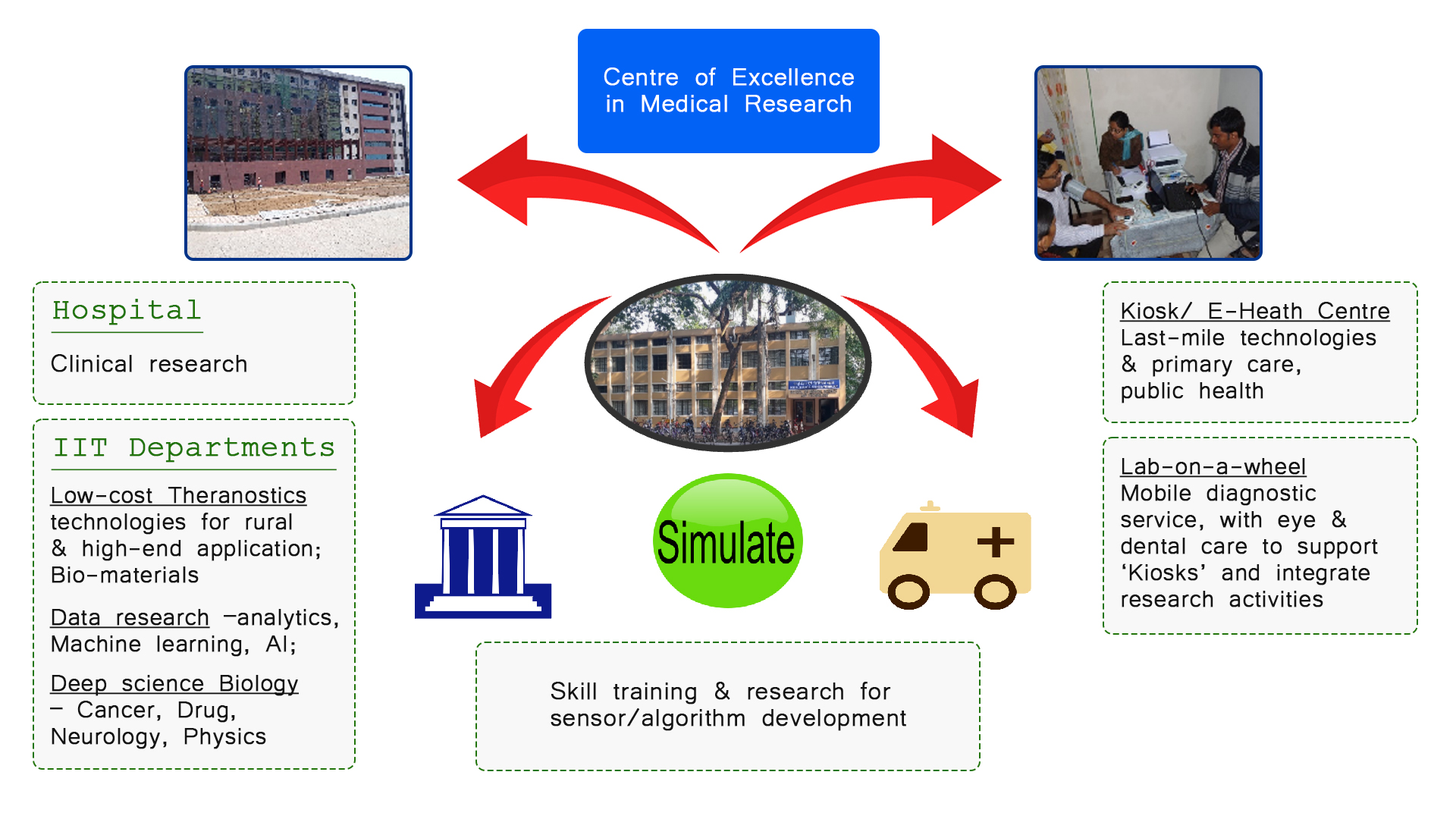
An Advanced Institute of Medical Science and Research
A note from our Principal Investigator
About DSIR, Govt. of India
The Department of Scientific and Industrial Research (DSIR) is part of the Ministry of Science and Technology, established through a Presidential Notification dated January 4, 1985, under the 164th Amendment of the Government of India (Allocation of Business) Rules, 1961. DSIR carries out activities relating to indigenous technology promotion, development, utilisation and transfer.
Its primary endeavour is to promote R&D by industry, support small and medium industrial units in developing globally competitive technologies, catalyse faster commercialisation of lab-scale R&D, and strengthen industrial consultancy and technology management capabilities — linking scientific laboratories with industrial establishments through the National Research Development Corporation (NRDC) and facilitating R&D investment through Central Electronics Limited (CEL). dsir.gov.in
About IIT Kharagpur
The Indian Institute of Technology Kharagpur (IIT Kharagpur) is a public institute of technology and research university established by the Government of India in Kharagpur, West Bengal. Established in 1951, it is the first of the IITs and is recognised as an Institute of National Importance.